
513-207-0476


2026 Hall of Fame Inductees

BILL JACKSON
bass-player
BILL JACKSON has been a musician since his earliest memories. Growing up with family musical influences, continuing with insightful public school teachers, and his own insatiable exploration has made him an oft-requested sideman. Starting in Fort Wayne, Indiana to Cincinnati, Ohio and beyond, his career has spanned five decades.
Bill’s music education started as a young person from family and friends. He watched, listened and learned from older siblings, forming guitar chords, and learning to read the notes on piano. He was introduced to the electric bass to fill a role in the family music group. He played trumpet in the public school band and was recruited to join the jazz band on bass. All of this led him to an undergrad experience in music education at Indiana University/Purdue University at Fort Wayne (IPFW). On a short hiatus from IPFW, Bill spent a semester at Berklee College of Music in Boston, MA, 1981. This semester was pivotal in his understanding of modern jazz and harmony. A three month, summer gig in a Colorado resort town gave Bill the opportunity to play modern jazz in a trio setting. He returned home to complete his bachelor’s degree in Music Education in 1986.
Armed with these varied experiences, Bill used some area connections to move to Cincinnati in 1986 and begin a career that would include both performance and education.
Opportunities to play started materializing and Bill’s interest in a wide variety of musical styles helped. Jazz standards, fusion, Latin, Caribbean, as well as Broadway musical productions and Vegas style shows are all a part of his repertoire. He has shared the stage with a variety of national players including pianists Les McCann and Mulgrew Miller, saxophonists, Steve Wilson, Javon Jackson and Tim Warfield, steel drum greats Ray Holman and Tom Miller, and has also been featured with composer/percussionist Roland Vasquez on his work “Music for 3 Mallets and Jazz Rhythm Section”. His theater credits include Wicked, Mean Girls, In the Heights, Mythic, and many others. He plays bass on several recordings: “J Curve Jazz Collection Vol. II”, Tropicoso “Un Cuento”, Bacchanal Steel Band “Standard”, 12 Rods “Split Personality” (V2 Records), among others. He has performed on stage with Joe Piscopo, Regis Philbin, and Don Rickles.
As an educator, Bill has mentored many aspiring bassists. His current and former students are busy, working musicians and teachers. He appeared on staff at Northern Kentucky University in the Jazz department for over a decade. Performances at PASIC, OMEA, and countless school assemblies have influenced young audiences. For several years he adjudicated at Miami University's Southern Ohio Jazz Band festival.
Bill is honored to be recognized and inducted into the Cincinnati Jazz Hall of Fame. His career is richer in great part due to his experiences with other CJHOF members. The list includes but is not limited to: John Von Ohlen, Mary Ellen Tanner, Lee Stolar, Cal Collins, Kenny Poole, Mike Wade, Melvin Broach, Marc Fields, Steve Schmidt, Pam Mallory, Wayne Yeager and Pat Kelly.
And while they rarely play together, Bill recognizes the Hall of Fame Bass players as instrumental in the success of all. Through recommendations, sharing of gigs, conferring on equipment and charts, there is a brotherhood of players who support each other and raise everyone up.
There are so many other Cincinnati players that share in Bill’s success. "'Possible future “Hall of Famer’s' or not, you are all valued, you know who you are," says Bill.
Bill Jackson currently resides in Cincinnati with his wife Angela and dog Bix! He enjoys family time with adult children, Anna, Sam and daughter-in-law, Skyeler. Music, entertainment and education are strong in this group! When not playing bass. He can be found exploring the back roads on two wheels.

JIMMY MADISON
drummer/producer
JAMES HENRY MADISON III was born in 1947, and at the age of four, his parents took Jimmy to a drum teacher because even at that young age, he would keep time banging on his highchair. Jimmy’s parents were musicians early in their lives, Jimmy’s mother played trumpet in big bands in Cincinnati and Jimmy’s father was a composer and good friend of trumpeter Bix Beiderbecke. By the time Jimmy was seven years old, his parents had purchased him his first real snare drum. At the age of 10 he started taking lessons from Jack Volk, a staff drummer at a local television station. It was Jack Volk who taught Jimmy at a very young age what he needed to know to become a working drummer.
The University of Cincinnati had it’s own radio station back in the day, WGUC, and on Saturdays, they would do a show called ‘UC Jazz Notes’. Jimmy played weekly on that show at the age of 13. By the time Jimmy was 14 years old he was playing weekly club dates in Cincinnati. It was then that Jimmy started to mimic his hero Joe Morello, Dave Brubeck’s drummer.
When Jimmy was 14 years old, he and his parents drove to New Orleans for vacation. While there, they all went to the Playboy Club to see Gerry Mulligan. Jimmy’s father cornered Gerry and told him what a fine drummer his son was and he should hear him play. Gerry gave him a shot and invited him up on stage. Jimmy was terrified, but after the tune Gerry complimented Jimmy. Years later Jimmy was playing professionally with Gerry.
Jimmy played with Dee Felice, Frank Vincent and Lee Stoller, while Jimmy was still in Deer Park High School! Jimmy’s band director, Frank Meisner, had to let him out of marching band on Friday nights, so that Jimmy could play his paying gigs. Jimmy was playing gigs in downtown Cincinnati at ‘The Living Room’, The ‘Whisper Room’ on Reading Road, as well as ‘The Blind Lemon’, ‘Mahogany Hall’ and ‘New Dilly’s Pub’ in Mt. Adams, still at the age of 14.
When Jimmy was 17 he first met Hall-of-Famer David Matthews, a man that would have a profound influence on his musical career. David was studying French Horn and Composition at Cincinnati Conservatory of Music and had formed a big band. One day, Jimmy got to sub for David’s drummer who couldn’t make the gig. That’s when Jimmy became David’s drummer.
After Jimmy graduated from Deer Park High School in 1965, he enrolled at Miami University in Oxford, Ohio. Jimmy studied music and geology. He formed a quartet while at Miami University and played for two years on Saturday evenings at the campus. A year later, trumpet player Don Goldie, hired Jimmy to be his drummer. Jimmy toured with Don Goldie until 1967. After that, Jimmy was hired by Lionel Hampton and moved to New York City. That’s when Jimmy’s career took off.
In 1974 Jimmy was walking in Riverside Park in NYC, and he saw his neighbor go by with a backpack. Jimmy asked him about it, and his neighbor said that on weekends he would go upstate NY to Harriman State Park for multi-day camping trips. The very next week Jimmy bought a couple of rucksacks and a cheap tent, and, started taking weekend camping trips himself. By 1976, Jimmy began taking amazing journeys mountain climbing, as well as rock climbing. Jimmy has climbed mountains in the Adirondacks, New Hampshire, Maine, The Rocky Mountains, as well as Mount Blanc in The Alps.
Jimmy also started his own recording studio in NYC in the 70’s. Jimmy recorded such artists as Tom Harrell, Harvie Swartz and The Brecker Brothers.
Jimmy has played with numerous musicians including Marion McPartland, James Brown, Bobby Hackett, Joe Farell, David Matthews, Roland Kirk, Carmen McRae, Harold Danko, Chet Baker, Urbie Green, Michel LeGrand, Don Sebesky, George Benson, Nina Simone, Art Farmer, Lee Konitz, to name a few. He has recorded over 50 LPs, as sideman, as well as leading his own groups.
Most recently Jimmy won a Grammy Award on Joyce DiDonato’s ‘Songplay’.
Jimmy’s biography was published in June of 2025. It’s called 'Jimmy Madison, Drummer Boy’ – ‘My Life Playing for the Greats of Jazz and Funk’ (With a Little Mountaineering on the Side)

ALLAUDIN (Bill) MATHIEU
composer, pianist, director, teacher, author
(In his own words) [Allaudin Photo Gallery]
I was born in 1937 into an upwardly mobile, bookishly intellectual, Jewish family. My early memories are of loving parents who cherished my older sister and me. I had a more internal than external life then as now, and my ear was caught early on by music. I studied classical piano formally from age six to fourteen and showed (i.e. showed off) noticeable aptitude but, by age thirteen, mid-century jazz had become my obsession. My Dad hired an inspiring teacher, Buddy Hiles, the reigning prince of Cincinnati’s Black music scene. I was unconditionally accepted by my new teacher and the musicians around him, and was invited to be an apprentice among them. They called me Buddy’s boy, and my ears opened wide in a new way.He introduced me to the music of the mid-century greats, Miles, Bird, Prez, Duke, and Stan Kenton, plus Bartok, and Stravinsky.
From middle school through high school I studied each week with Buddy, led a believable jazz dance band, played gigs around Cincinnati on piano and trumpet, arranged and composed music for Buddy’s big band. Pianist Leonard Stoller, and saxophonist Gordon Brisker, both inductees into the Cincinnati Jazz Hall of Fame, were high school colleagues. When I was fourteen, after a Stan Kenton concert at Orchestra Hall, I approached Stan and said “I want to write for your band.” With his impeccable generosity, Stan replied, “Well sure you can write for my band,” and for the next three years whenever the band played at Cincinnati Gardens, I appeared at a rehearsal with charts under my arm and the band ran them through. Writing for Kenton became my obsession. During my five years at Walnut Hills I earned middling grades, but on the basis of a Concerto I wrote for the high school orchestra, I was accepted to the University of Chicago as an early entrant. At age seventeen I left home with a few sighs and a sense of the miracles to come.
During my college years I studied privately with, Bill Russo, who had spent years writing music for the Kenton band. On occasion, Kenton generously rehearsed my music but he didn’t hire me, a green college kid. I finished my Hutchins BA in 1958 as only a B student, but a student who in fact had been trained to think, to read, and to write. In a moment of clarity I signed up for an MA in English under Norman Maclean. At the end of my first post-grad semester, however, Kenton in fact did hire the twenty-one-year old me to be a staff arranger and composer for the band.
I spent 1959 writing music for Stan Kenton and traveling on and off with the band as a (fourth) trumpet player. In the fall of that year an album of my arrangements was recorded and released on Capitol Records, and though that was quite an honor, I’d had enough of the jazz road musician’s life. Subsequently, I wrote music for Duke Ellington, Maynard Ferguson, and the Four Freshman. My experiences with Duke Ellington were illuminating, and are still bright in my heart. Those few years writing for big bands are chronicled at length in my memoir (see below). In 1963 I caught the ear and eye of Gene Less, then editor of DownBeat, and began writing a theory column and record reviews for the magazine.
The day I left the Kenton band I was asked to be a founding member of the Second City, the highly influential and first commercially successful troupe of improvising actors. Many of these were older U of Chicago graduates and I suddenly found myself in a socially aware, uniquely talented crew of theatrical crazies. As their pianist/musical director I was, at twenty-two, the baby of the company but perforce the baby grew up fast. Those years were heady, nuts, collaborative and enormously creative, and we got famous (to the eventual detriment of all) almost overnight.
The theater work gave me ample private time to become a better musician and, the student being ready, the next true teacher appeared. Easley Blackwood (b.1933) was an up-and-coming American composer, and newly hired professor at U. of Chicago, who quickly became my friend. After a short while, in exchange for a lid of weed a week, Easley became my musical mentor as well. Through the lineage of the French master teacher, Nadia Boulanger, he taught me the Eurocentric lineage of classical music, which I adored but had scarcely understood. For five years we had a lesson every week, and I learned the evolution of the western ear by studying the history of its music, its infrastructure, and its masterpieces. Meanwhile, I was practicing piano relentlessly.
In 1966 I married Kay (Hafiza) Mathieu, adopted her two kids, Atha and David, and wife and husband began to increase the family population. We agreed to move to San Francisco, where a job with the Second City’s sister theater, The Committee, awaited me. We arrived in 1967, just in time for the blooming of the Haight and The Summer of Love.
In the spring of 1968, Hafiza led me to the Sufis. My Murshid (teacher) was Samuel Lewis, and with his blessing I formed the Sufi Choir. I was given the name Allaudin (allow-deen), which translates as “guide.” (The Anglicization is Aladdin, he of the magic lamp). My new musical family of Sufis has become a touchstone for my life. The Sufi Choir toured both coasts for years, including collaborations with tabla player Zakir Husain, and the Grateful Dead, among many others.
Hafiza and I had two daughters together in 1967-68, Lucy Amadea and Amy Moon. We were then a family of six. I got a good job at the San Francisco Conservatory of Music teaching keyboard harmony, counterpoint, and improvisation, was playing nightly at The Committee Theater, and continually being blessed by the music we of the Sufi Choir were making, In 1968 our family moved into a proper house in San Anselmo, just north of San Francisco .
I met the master North Indian vocalist Pandit Pran Nath in 1971, began studying raga with him in 1974, and was initiated as disciple in 1987. With prescient patience, Pandit Pran Nath led me to the path from ancient modal purity to modern harmonic practice. Also in the early 70s, Hamza El-Din, the Nubian vocalist and oudist, was welcomed into the Sufi family, delighting and instructing us. Hamza and I quickly bonded, and for thirty years he became my big brother, friend, collaborator, and mentor of African sensibilities. Thus, the collective guidance of my teachers—Buddy Hiles, the panoply of my jazz idols, Easley Blackwood, Sufi Samuel Lewis, Pandit Pran Nath, and Hamza El-Din—has become the heart of my music and my teaching.
From 1974 to 1980 I taught classes in music theory and practice at Mills College. In the mid-eighties I had the impulse to write books about music. I knew I had something to say that had not yet been said. Thus began the long journey of a diligent if reluctant author. Five books ensued, reaching (so far) well over 100,000 readers—each of whom is my cherished companion. Along the way I’ve been encouraged by poet Coleman Barks (who called words, in a splendid book about poetry, those silver-tongued protectors of illusion).
In the early 2000s, a polished, swinging big band from Milwaukee-St. Paul conducted by Mike Krikava brilliantly recorded and released all of my charts not recorded by Kenton. In that same period I conducted annually for three years a big band concert of my Kenton charts , then Bill Russo charts (difficult), and then Pete Rugolo charts (scary).
My present wife, Devi, and I became partners in 1982 and were married in 1987. Devi is the light of my life, my musical collaborator; we sustain each other in a kind of heaven world that is our daily life together. She is also my first reader and sharp-eyed editor whose literary insight has saved—or deleted—many a paragraph.
For the last forty-five years I have been living surrounded by green trees, grazing cows, and peaceful neighbors, under the beacon of transmission from my many teachers. My commission is to guide, through my craft and aesthetic, as I myself have been guided by so many illuminated ones. In 2023 my memoir, The Shrine Thief, was published by TerraNova/MIT Press and the story there, you can be sure, is longer.
As of this writing I am one year old for each key on the pianoforte (……think about it).
All of my books (five) and recordings (somewhere over forty), plus photos and more are displayed at coldmountainmusic.com.
W. A. Mathieu, April 2026

KATHY WADE
vocalist/producer
For more than five decades, KATHY WADE’s voice has been a defining presence in
Cincinnati’s jazz landscape, rooted in tradition, rich in soul, and unmistakably her own. A two-time Regional EMMY® Award-winning Executive Producer and internationally acclaimed jazz vocalist, Kathy is honored for a lifetime of performance excellence that has carried Cincinnati’s sound to stages around the world.
Named the #1 Jazz and Blues Vocalist on MP3.com, her recording “Time to Say Good-bye” topped the Jazz Vocal charts and was featured on the Sci-Fi Network’s First Wave
soundtrack. Her artistry has also been highlighted in Essence Magazine for its powerful connection between music, storytelling, and education.
Kathy’s performance journey began more than 50 years ago in competitions and solo recitals, evolving into an international career spanning the United States, Canada, Europe, the Caribbean, and North Africa. Her recordings include You Got the Magic, J Curve
Cincinnati Jazz Collection, Vol. II, The Next Noel, and her forthcoming self-titled release Kathy Wade. The video for her single “Someone’s In Love” earned an EMMY®, a TELLY Award, and multiple international film honors.
Throughout her career, Kathy has shared stages with legends including Eartha Kitt, Dionne Warwick, Nancy Wilson, Shirley Horn, Diane Schuur, Anita Baker, George Benson, Al
Jarreau, Whitney Houston, and Ramsey Lewis. She is a featured soloist with the Cincinnati Pops Orchestra, Cincinnati Chamber Orchestra (Summermusik), and Kentucky Symphony Orchestra, and has received critical acclaim for her work in Cincinnati Playhouse’s Ain’t Misbehavin’, Beehive, and Crowns.
Kathy co-founded Learning Through Art, Inc., which has built community through art and impacted over one million participants for more than three decades. She is the creator and
executive producer of the national award-winning and multiple regional EMMY-winning performing arts literacy program Books Alive! For Kids®. Learning Through Art anchors Kathy’s belief in giving back to the community.
A proud Cincinnati native, Withrow High School alum, graduate of Xavier University/Edgecliff College and College-Conservatory of Music, University of Cincinnati, Kathy accepts this Hall of Fame honor with deep gratitude—for the family, mentors, musicians, and audiences who shaped her journey—and with a continued commitment to honoring jazz as a living, evolving art form.

Scholarships
Winner of Don Steins Memorial Scholarship
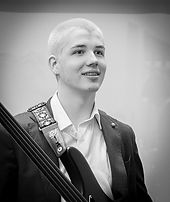
J.J. MANGAN
bass
Born in Cincinnati, Ohio, this talented young musician discovered his passion for the bass at just nine years old and quickly found his voice in jazz by seventh grade. That same year, he joined Jazz at Dusk, a program that would play a pivotal role in shaping both his musical journey and personal growth. Now a senior at Walnut Hills High School, he has been performing professionally since his freshman year, steadily building experience and confidence on stage in both jazz and rock.
This fall, he will continue his journey at the University of South Carolina, where he plans to pursue a double major in Finance and International Business at the Darla Moore School of Business. He credits Jazz at Dusk for providing not only invaluable musical training, but also mentorship, community, and life lessons that have helped shape him into the musician and person he is today.